Discover how algebra, geometry, calculus, and physics shape every shot, pass, and save on the ice. Interactive visualizations bring the math to life.
From calculating shooting percentages to predicting player statistics, algebra is fundamental to understanding hockey performance.
When a hockey player shoots the puck, we can calculate how fast it's moving using a simple formula.
If a puck travels 60 feet in 0.5 seconds, its speed is 60 ÷ 0.5 = 120 feet per second!
A gentle pass covering 30 feet in 1.5 seconds has a speed of 30 ÷ 1.5 = 20 feet per second.
Professional players can shoot the puck at over 100 MPH, which is about 147 feet per second.
A puck traveling the full rink length (200 feet) in 2 seconds moves at 200 ÷ 2 = 100 ft/s (68 MPH).
We can rearrange the velocity equation to solve for different variables and analyze more complex scenarios.
Player A shoots from 60 ft at 120 ft/s (t = 0.5s). Player B from 45 ft at 90 ft/s (t = 0.5s). They arrive simultaneously!
A puck shot at 90 MPH (132 ft/s) must travel 89 feet (goal line to goal line). Time = 89/132 ≈ 0.67 seconds.
Convert 100 MPH to ft/s: 100 × 1.467 = 146.7 ft/s. This is crucial for comparing speeds in different units.
Puck goes from 0 to 88 ft/s (60 MPH) in 0.1s during a slap shot. Acceleration = 88/0.1 = 880 ft/s²!
Advanced algebraic concepts model puck collisions, deflections, and multi-directional motion.
When a puck (6 oz) deflects off a stick blade, momentum conservation predicts the new trajectory angle and velocity.
NHL teams use vector analysis to optimize tip-in locations where deflected shots are most likely to score.
Shooting percentage tells us how often a player scores when they shoot the puck.
If a player scores 15 goals on 100 shots, their shooting percentage is (15/100) × 100 = 15%.
20 goals on 90 shots = (20/90) × 100 = 22.2%. This is an elite level shooting percentage!
An average NHL player with 8 goals on 80 shots = (8/80) × 100 = 10%.
Over 5 seasons: 150 goals on 1,200 shots = (150/1200) × 100 = 12.5% career shooting percentage.
We can use algebra to predict future performance and compare players across different sample sizes.
If a player maintains 12% shooting and takes 250 shots in a season, expected goals = 250 × 0.12 = 30 goals.
Advanced statistical analysis accounts for variance, confidence intervals, and probabilistic outcomes.
A player with 5 goals on 10 shots (50%) likely doesn't have a true 50% shooting percentage—the sample is too small.
NHL teams use multiple regression to model shooting % as a function of shot distance, angle, traffic, and shooter skill.
Hockey is played on a precise geometric surface. Understanding angles, distances, and spatial relationships is crucial for strategy.
The angle between a shooter, the puck, and the goal determines how much net the shooter can see.
Shooting from directly in front of the goal (center ice) gives the widest angle and best scoring chance.
Shooting from the side (near the boards) creates a sharp angle where the goalie blocks most of the net.
The "slot" (15-30 feet from goal, center ice) offers angles of 20-40 degrees—ideal for scoring.
From the corner (5 feet from boards, 10 feet from goal), the angle might be only 5-10 degrees—very difficult!
From the blue line (60 feet out, center ice), the angle is about 2×arctan(3/60) ≈ 5.7 degrees—much narrower than the slot!
NHL rink: 200 feet long × 85 feet wide. The goal is 6 feet wide × 4 feet tall, creating specific geometric targets.
We can calculate the exact shooting angle using trigonometric functions.
From 30 feet away and 10 feet to the side: angle ≈ 2 × arctan(3/30) ≈ 11.3 degrees of net visible.
The "slot" (center area 15-30 feet from goal) provides angles of 20-40 degrees—the sweet spot for scoring.
From the point (60 ft away): angle = 2×arctan(3/60) × (180/π) ≈ 5.7 degrees. Explains why point shots rarely score!
Goalie is ~2 feet wide. At 10 feet away, goalie blocks arctan(1/10) × (180/π) × 2 ≈ 11.4 degrees of the total angle.
Advanced geometry models the three-dimensional cone of possible shot trajectories.
NHL analytics teams create geometric heat maps showing xG from every ice position, accounting for angle, distance, and occlusion.
Defenders position to minimize opponent shooting angles—a geometric optimization problem.
To pass the puck successfully, players need to judge distances accurately.
Player at (10, 20) passes to teammate at (30, 20). Distance = √[(30-10)² + (20-20)²] = √400 = 20 feet.
From (0, 0) to (30, 40): Distance = √[(30)² + (40)²] = √2500 = 50 feet.
From (20, 10) to (20, 75) (across the rink width): Distance = √[(0)² + (65)²] = 65 feet straight across.
From defensive zone (30, 40) to offensive zone (170, 50): Distance = √[(140)² + (10)²] = √19,700 ≈ 140 feet!
Three forwards at (50,25), (50,60), and (30,42.5). Distances: √[(0)²+(35)²]=35 ft, √[(20)²+(17.5)²]≈26.5 ft, √[(20)²+(17.5)²]≈26.5 ft.
From behind goal (5, 42.5) to wing (25, 70): Distance = √[(20)² + (27.5)²] = √1256.25 ≈ 35.4 feet—quick decision needed!
The distance formula comes directly from the Pythagorean theorem applied to coordinate geometry.
Player A at (20, 30) passes to Player B at (50, 50). Distance = √[(50-20)² + (50-30)²] = √[900 + 400] = √1300 ≈ 36 feet.
Using \(\arctan\left[\frac{y_2-y_1}{x_2-x_1}\right]\), we can calculate the angle to aim the pass.
Advanced geometric analysis models all possible passes as a vector field across the ice surface.
AI systems calculate thousands of potential passes per second, evaluating which lanes are open using line-segment intersection algorithms.
Three players forming a triangle maximize passing options—any two players have a direct passing lane.
Trigonometric functions are essential for analyzing angles, trajectories, and the relationship between forces in hockey.
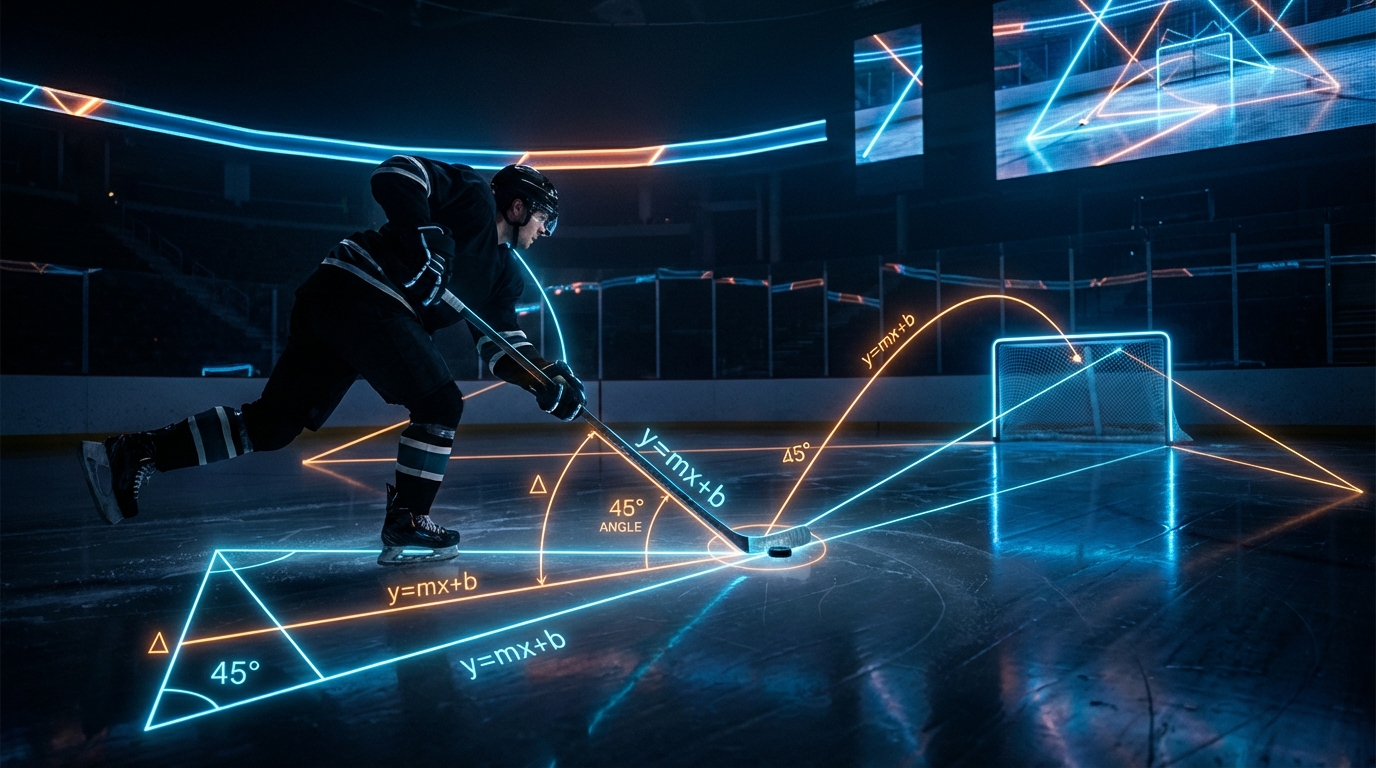
When a player shoots at an angle, we can use right triangles to understand the geometry of the shot.
If a player is 30 feet from goal and 15 feet to the side, tan(angle) = 15/30 = 0.5, so angle ≈ 27°.
A puck shot at 30° travels horizontally 60 feet. Its maximum height involves sin(30°) = 0.5.
From the corner (40 ft away, 28 ft to side): tan(θ) = 28/40 = 0.7, giving angle of about 35°.
From the slot (25 ft away, 5 ft to side): tan(θ) = 5/25 = 0.2, giving angle of about 11° from center.
Shooting upward at 10°: if speed is 100 ft/s, vertical component = 100×sin(10°) ≈ 17.4 ft/s, horizontal = 100×cos(10°) ≈ 98.5 ft/s.
Puck hits boards at 30° angle. Reflection angle also 30° (angle in = angle out). Use tan(30°) ≈ 0.577 to calculate position.
Trigonometry extends beyond right triangles to analyze any angle and rotational motion.
A shot with initial velocity 100 ft/s at 20° has horizontal component: v_x = 100 × cos(20°) ≈ 94 ft/s.
Same shot has vertical component: v_y = 100 × sin(20°) ≈ 34 ft/s upward.
If horizontal velocity is 80 ft/s and vertical is 60 ft/s, angle = arctan(60/80) ≈ 37°.
To pass from (20,30) to (50,60), the angle is arctan[(60-30)/(50-20)] = arctan(1) = 45°.
From 20 ft away, to hit crossbar (4 ft high): angle = arctan(4/20) = arctan(0.2) ≈ 11.3° above horizontal.
Puck approaches at 25°, stick redirects at 60° to ice. Change in angle: 60° - 25° = 35° deflection using trig identities.
Complex trigonometric analysis models periodic motion, oscillations, and wave-like patterns in player movement.
Three players form a triangle. Sides 20ft, 30ft, angle between is 60°. Third side = √(400+900-2×20×30×0.5) ≈ 26.5ft.
Player's x-position oscillates: x(t) = 40 + 20cos(πt). This periodic motion has amplitude 20ft, period 2 seconds.
A 150 lb force at 25° to ice: horizontal component = 150cos(25°) ≈ 136 lb, vertical = 150sin(25°) ≈ 63 lb.
Blade at 35° to ice applies force F. Puck acceleration uses F×cos(35°) for forward motion component.
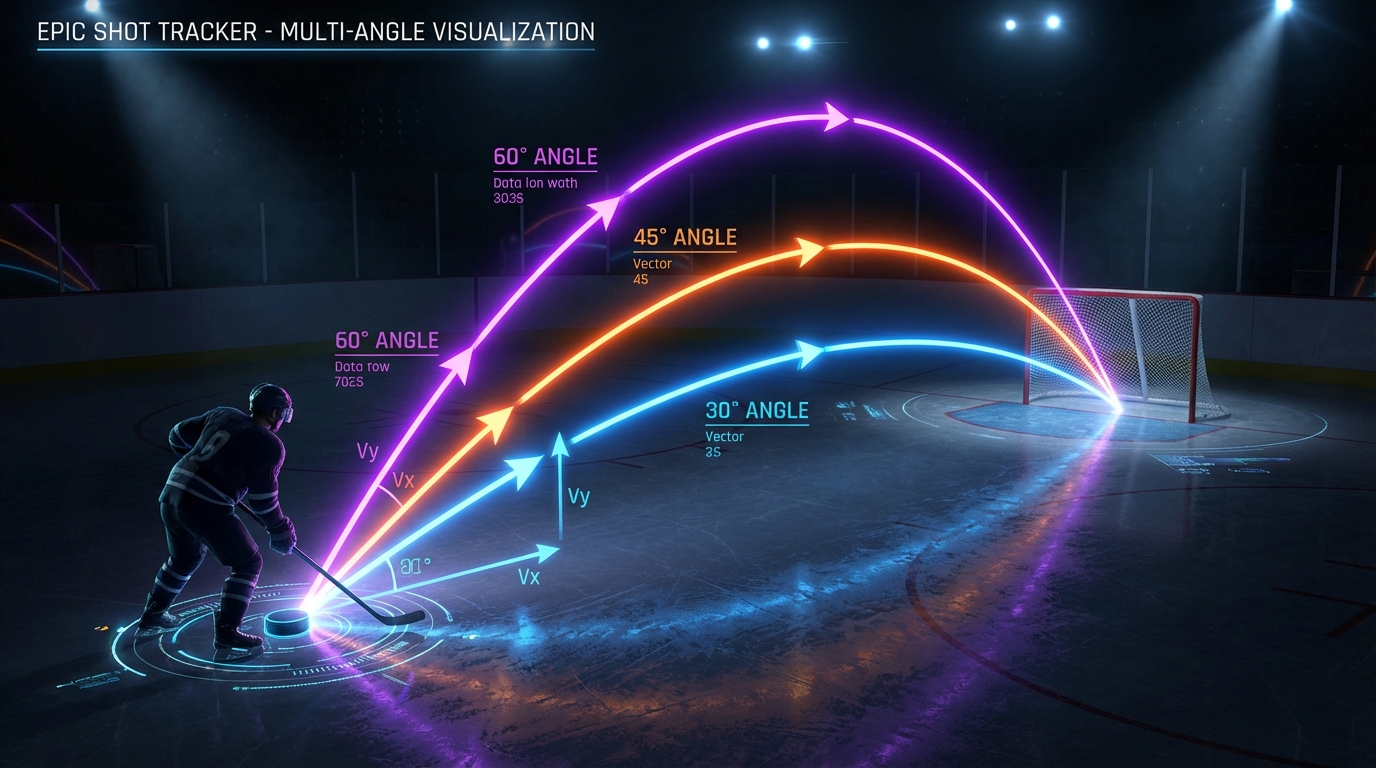
When a player shoots the puck at an angle (not straight ahead), the puck's path splits into horizontal and vertical motion.
A shot straight ahead (0° angle) has all its speed going forward, none going up or down.
A shot at 45° splits the speed equally between forward motion and upward motion.
A 60° shot goes more up than forward—useful for clearing the puck out of the defensive zone.
A 15° shot keeps most speed going forward with just a slight rise—perfect for top-shelf goals.
A "saucer pass" lifts at 20° to clear sticks. If shot at 60 ft/s, it rises 60×sin(20°) ≈ 20.5 ft/s vertically.
Coming around the net at 80° angle: nearly all motion is sideways (sin(80°)≈0.98), very little forward (cos(80°)≈0.17).
Breaking velocity into components using sine and cosine lets us predict where the puck will land.
Shot at 80 ft/s at 30°: v_x = 80cos(30°) ≈ 69 ft/s, v_y = 80sin(30°) = 40 ft/s.
For a 100 ft/s shot: Range = (100)²sin(90°)/32.2 = 10,000/32.2 ≈ 310 feet at 45° angle!
Shot at 60 ft/s at 40°: time = 2v_y/g = 2×(60sin40°)/32.2 ≈ 2.4 seconds in the air!
A 10° shot at 120 ft/s: v_x = 120cos(10°) ≈ 118 ft/s forward, v_y = 120sin(10°) ≈ 21 ft/s up.
To maximize distance, shoot at 45°! At 90 ft/s: Range = (90)²×sin(90°)/32.2 = 8100/32.2 ≈ 252 feet maximum possible!
Shot from 15 ft at 25°, 80 ft/s. At goal: time = 15/(80cos25°) ≈ 0.207s. Height = 80sin(25°)×0.207 - 16.1×(0.207)² ≈ 6.3 ft. Clears 4 ft bar!
Calculus combined with trigonometry optimizes shot angles for specific situations.
From 20 ft away, 4 ft height, clear 4 ft crossbar: minimum angle θ where 20tan(θ) ≥ 4, so θ ≥ arctan(0.2) ≈ 11°.
Goalie at 6 ft away, 5 ft tall, shooter 25 ft out: angle to clear = arctan[(5-3)/(25-6)] ≈ 6° minimum.
Optimize flip angle from 100 ft: accounting for drag, optimal angle is ≈ 35° for maximum distance with elevation.
From 30 ft, hit top corner at (30, 0, 4): requires sin(θ) = 4/√(30²+4²) where total distance is hypotenuse.
When the puck spins or players turn, we measure rotation in degrees or fractions of a full circle.
A player makes a 90° turn (quarter circle) to change direction from skating forward to skating sideways.
A puck spinning at 180° (half rotation) per second completes a full rotation every 2 seconds.
A figure skater does a complete 360° spin—that's one full rotation around their axis.
A slap shot puck can spin at 1,000+ RPM (revolutions per minute)—over 16 complete rotations per second!
A player making a 180° turn (π radians) in 0.8 seconds has angular velocity ω = π/0.8 ≈ 3.93 rad/s.
Skating a full circle (360° = 2π radians) in 4 seconds: ω = 2π/4 ≈ 1.57 rad/s (one quarter turn per second).
Angular velocity measures how fast something rotates, typically in radians per second.
Puck spinning at 600 RPM = 600 × 0.105 ≈ 63 rad/s angular velocity.
Puck (radius 1.5 inches = 0.125 ft) spinning at 60 rad/s: edge speed = 0.125 × 60 = 7.5 ft/s!
Player turns 90° (π/2 radians) in 0.5s: angular velocity = (π/2)/0.5 ≈ 3.14 rad/s.
Skating in a 10 ft radius circle at 20 ft/s: angular velocity = v/r = 20/10 = 2 rad/s.
During a wrist shot, blade rotates 45° (π/4 rad) in 0.05s: ω = (π/4)/0.05 ≈ 15.7 rad/s—very fast motion!
Puck spinning at 720 RPM: ω = 720 × (2π/60) = 720 × 0.1047 ≈ 75.4 rad/s angular velocity.
Advanced rotational physics uses trigonometry to analyze spinning objects and torque.
6 oz puck (0.17 kg), radius 0.038 m: I = ½(0.17)(0.038)² ≈ 0.00012 kg·m². At 60 rad/s: L = 0.0072 kg·m²/s.
Ice friction creates torque τ = F×r. If F = 0.01 N at edge, τ = 0.01 × 0.038 ≈ 0.00038 N·m decelerates spin.
Spinning puck at ω = 50 rad/s creates lift force perpendicular to velocity. Curve depends on sin(θ) where θ is spin axis angle.
Puck spinning at 60 rad/s: KE_rot = ½(0.00012)(60)² ≈ 0.22 J—small compared to translational KE but affects stability!
Calculus helps us understand how things change over time—essential for analyzing acceleration, trajectory curves, and optimization.
Speed tells us how fast something is moving. Acceleration tells us how fast the speed is changing.
If a puck slides at 50 ft/s the whole way, acceleration is zero—no change in speed.
A slap shot accelerates the puck from 0 to 147 ft/s (100 MPH) in 0.1 seconds: a = 1,470 ft/s²!
A puck at 100 ft/s decelerates at -0.3 ft/s² due to friction. After 10s: v = 100 - (0.3 × 10) = 97 ft/s.
Wrist shots have lower acceleration than slap shots: 0 to 88 ft/s (60 MPH) in 0.05s gives a = 1,760 ft/s².
Calculus introduces the derivative, which gives us instantaneous rates of change.
If a = 10 ft/s², the puck gains 10 ft/s of velocity every second.
When acceleration becomes zero (a = 0), velocity reaches its maximum or minimum.
Multi-dimensional calculus models the puck's motion in both horizontal directions and vertical (when airborne).
NHL tracking systems use Runge-Kutta methods to solve these differential equations and predict puck trajectories in real-time.
Calculus of variations finds the optimal launch angle and velocity to maximize shooting accuracy given constraints.
Let's break down a puck's flight into small time steps to see exactly how it moves. We'll shoot at 30° with initial speed of 80 ft/s.
Simple pattern: Horizontal speed stays constant (no gravity sideways!)
Key Insight:
The horizontal position increases linearly with time because there's no horizontal force acting on the puck. Each time step adds exactly the same distance!
Complex pattern: Gravity pulls down, so vertical speed decreases each step!
Key Insight:
The vertical position follows a parabolic curve because gravity continuously accelerates the puck downward. The puck rises quickly at first, slows down, reaches a peak, then falls!
The puck's position at each moment combines both dimensions:
| Time (s) | X Position (ft) | Y Height (ft) | Position (x, y) |
|---|---|---|---|
| 0.0 | 0.00 | 3.00 | (0, 3) |
| 0.1 | 6.93 | 6.84 | (6.93, 6.84) |
| 0.2 | 13.86 | 10.36 | (13.86, 10.36) |
| 0.3 | 20.79 | 13.57 | (20.79, 13.57) |
| 0.4 | 27.72 | 16.45 | (27.72, 16.45) |
| 0.5 | 34.65 | 19.02 | (34.65, 19.02) |
✨ These points trace out a curved path—the puck's trajectory!
Key Insight:
When we plot the X and Y positions together, we see the classic parabolic trajectory! The puck moves forward at a constant rate while simultaneously rising and falling due to gravity.
What happens if we make the time steps smaller and smaller?
🎓 Calculus finds the exact position at ANY instant by using a mathematical limit as the time step approaches zero. Instead of adding up tiny changes, we use derivatives and integrals to get perfect accuracy!
Instead of calculating position at individual time steps, calculus gives us formulas that work for ANY time!
Same example: 80 ft/s at 30°, starting at 3 ft height
At t = 0.5 seconds:
Iteration method: x = 34.65 ft, y = 19.02 ft (from adding 5 steps)
Calculus formula:
x(0.5) = 0 + 69.3×0.5 = 34.65 ft
y(0.5) = 3 + 40×0.5 - ½×32.2×(0.5)² = 3 + 20 - 4.025 = 18.975 ft
✓ Same answer! But calculus gives it instantly, no iteration needed.
Taking the derivative gives us velocity at any moment:
Taking the derivative again gives us acceleration:
The puck reaches maximum height when vertical velocity = 0:
Set v_y(t) = 0:
40 - 32.2t = 0
t = 40/32.2 ≈ 1.24 seconds
Substitute into y(t):
y(1.24) = 3 + 40(1.24) - 16.1(1.24)² = 3 + 49.6 - 24.77 ≈ 27.8 feet
The puck reaches 27.8 feet at its peak!
Iterations show us HOW calculus works by adding up tiny changes. Calculus formulas give us the EXACT answer by taking the mathematical limit as those changes become infinitely small. This is the power of derivatives and integrals—they turn step-by-step arithmetic into instant, precise calculations!
When forces change continuously (like drag that depends on velocity), we need differential equations and return to iteration methods—but much more sophisticated ones!
Simple projectile motion (constant gravity) has exact formulas. But add air resistance, and suddenly we need numerical methods—fancy iterations!
The basic idea: Use derivatives to predict the next small step
More accurate than Euler—samples the derivative at multiple points per step
The RK4 approach:
Result: With the same step size, RK4 is ~100× more accurate than Euler!
80 ft/s shot at 30° with air resistance included:
| Method | Step Size | Max Height | Accuracy |
|---|---|---|---|
| No drag formula | N/A | 27.8 ft | Exact (but unrealistic) |
| Euler | 0.1s | 26.2 ft | ±5% error |
| Euler | 0.01s | 26.45 ft | ±0.5% error |
| RK4 | 0.1s | 26.48 ft | ±0.01% error |
| NHL tracking systems use RK4 with Δt = 0.001s for real-time trajectory prediction! | |||
When the puck spins, it curves! This adds another force to our differential equations:
We started with simple iterations to understand motion step-by-step.
Calculus gave us exact formulas for simple cases (constant forces).
But real physics brings us back to iteration—sophisticated numerical methods that use calculus (derivatives) at each tiny step to handle complex, changing forces.
This is how modern physics works: analytical calculus provides insight, numerical calculus provides solutions!
NHL player tracking systems (like NHL Edge IQ) use these exact methods to:
Physics principles govern every aspect of hockey, from collisions to friction to energy transfer.
Kinetic energy is the energy an object has because it's moving. Faster = more energy!
A 6-oz puck at 100 ft/s: KE = ½ × (0.375 lb) × (100)² ÷ 32.2 ≈ 58 ft-lb of energy!
Same puck at 200 ft/s has KE = ½ × 0.375 × (200)² ÷ 32.2 ≈ 233 ft-lb—four times more energy!
A 200-lb player at 20 MPH (29.3 ft/s): KE = ½ × 200 × (29.3)² ÷ 32.2 ≈ 2,665 ft-lb—huge impact!
A goalie stopping a 100 MPH shot (147 ft/s) absorbs about 125 ft-lb of energy in their catching glove!
The work done on an object equals its change in kinetic energy.
A 6-oz puck at 100 MPH: KE = ½(0.17 kg)(44.7 m/s)² ≈ 170 Joules—enough to seriously injure someone!
If a player accelerates a puck to 100 MPH in 0.1 seconds, power = ΔKE/Δt = 170J/0.1s = 1,700 Watts!
Real systems lose energy to friction, deformation, and other dissipative forces.
e = √(KE_after/KE_before) for collisions. Hockey pucks on ice: e ≈ 0.6 (60% energy retained in bounce).
Elastic potential energy stored in stick flex: U = ½kx². When released, converts to puck KE—adding 10-15 MPH to shot velocity.
Friction is a force that opposes motion. Even though ice is slippery, friction still slows the puck.
A 6-oz (0.375 lb) puck at 100 ft/s has momentum = 0.375 × 100 = 37.5 lb·ft/s.
A 180-lb player skating at 20 ft/s has momentum = 180 × 20 = 3,600 lb·ft/s—nearly 100× more than the puck!
Player A (200 lb, 15 ft/s) hits Player B (180 lb, -10 ft/s). Total momentum before = 3,000 + (-1,800) = 1,200 lb·ft/s.
Ice friction force of 0.01 lb on a 0.375 lb puck creates deceleration of 0.01/0.375 × 32.2 ≈ 0.86 ft/s².
Newton's laws govern all motion in hockey.
a = F_f/m = μg ≈ 0.32 ft/s². A puck at 100 ft/s takes about 300 feet to stop!
J = FΔt = Δp. A stick in contact with puck for 0.02s delivering 100 lb force: Δp = 2 lb·s, changing velocity dramatically.
Advanced physics of ice friction involves thin water layers, pressure melting, and viscoelastic deformation.
For player-player collision: m₁v₁ + m₂v₂ = m₁v₁' + m₂v₂'. Combined with energy equation gives post-collision velocities.
In multi-player collisions, center of mass velocity: v_cm = (m₁v₁ + m₂v₂)/(m₁ + m₂) remains constant.
Real hockey scenarios involve multiple mathematical concepts working simultaneously.
Player evaluates angle to goal using trigonometry: θ = 2·arctan(3/d). Finds optimal shooting position.
Player flexes stick (elastic PE stored). Releases: F = ma accelerates puck. Kinetic energy = ½mv².
Differential equations model path: x(t), y(t), z(t). Gravity and drag affect motion continuously.
Statistical model: P(goal) = f(angle, distance, velocity, goalie position). Uses regression from thousands of shots.
Every aspect of hockey—from the design of the rink to the curve of a slap shot—relies on mathematical principles. Players who understand these concepts, even intuitively, gain a competitive advantage. And for fans and analysts, mathematics reveals the hidden beauty and complexity of the game.