The Enclave: Fallout's Ultimate Evil

From Deep State Conspiracy to Post-Apocalyptic Fascism

Tracing the shadowy organization's journey from Fallout 2's oil rig to the TV series' Rocky Mountain facility—and what their return means for the franchise's future.

Who Are the Enclave?

The Enclave is a secretive faction appearing as a major antagonist throughout the Fallout series, first as the main villain in Fallout 2 and again in Fallout 3. But to truly understand this organization, you must look beyond their post-apocalyptic military power to their origins as something far more insidious: the American deep state made manifest.

The Enclave is based on the conspiracy theory of the 'deep state,' which believes that high-ranking members of the government, alongside big corporation leaders, are running North America from behind the scenes. Before the nuclear holocaust of 2077, the Enclave consisted of the nation's most elite individuals—corporate executives, military generals, influential scientists, and even the President of the United States himself. They operated in secret, pulling strings from the shadows while the American public remained oblivious to their machinations.

What separates the Enclave from other Fallout factions is the scope of their ambition and the depth of their malevolence. With branches in the American southwest and greater Washington, they serve as a paramilitary organization founded by high-ranking US government officials attempting to restore said government, which has become a military dictatorship in the Fallout universe. Their debut appearance in Fallout 2 (1998) and return in Fallout 3 (2008) depict them attempting to restore their power via eugenics and genocide through military force, a practice that continues to be a staple of the faction in their appearances since.

Core Ideology

Democratic (nominally) Fascism (de facto) Anti-communism American exceptionalism Pseudo-scientific racism, social Darwinism, and anti-mutant hate Clear delineation of castes, with the society of the Enclave divided into military, science, and civilian categories.

The Enclave's vision for America's future is built on a foundation of racial purity and technological supremacy. They view themselves as the only "true humans" left—genetically untainted by radiation—and believe it is their manifest destiny to cleanse the wasteland of all "impure" life. This includes not just super mutants and ghouls, but ordinary wastelanders whose ancestors survived the apocalypse on the surface, accumulating trace amounts of radiation over generations.

Origins: The Vault-Tec Connection

One of the Enclave's most sinister achievements came through their partnership with Vault-Tec Corporation. The Enclave was deeply interested in Project Safehouse, an initiative led by the Vault-Tec corporation to construct a series of vaults as a safe haven for the American population, keeping the country alive in the (likely) case of nuclear bombs being dropped. This was an initiative publicly sanctioned by the government, but its true purpose was far more sinister than mere safety. In reality, only 17 of the 122 Vaults were meant as safe places during a nuclear holocaust. The rest were meant as behavioral and biological experiments to be conducted by the backers of Vault-Tec, the Enclave being chief among them.

This revelation recontextualizes the entire Fallout narrative. Every horrifying vault experiment—the forced evolution chambers, the white noise torture, the sacrificial systems—can be traced back to the Enclave's scientific ambitions. They weren't just preparing for the end of the world; they were actively studying how humanity would adapt, fracture, and evolve under extreme conditions.

In the end, the Enclave, Vault-Tec and many other large players were counting on nuclear conflict to happen, making peace not an option for them. This is why, as the Fallout TV show proposes, it was likely due to the Enclave's meddling that the Great War started in the first place.

"Any humanoid that isn't inoculated against its effects before its release, will die. That is the Project." President Dick Richardson on the Enclave's genocidal plans (Fallout 2)

Fallout 2: The Oil Rig and Project Purity

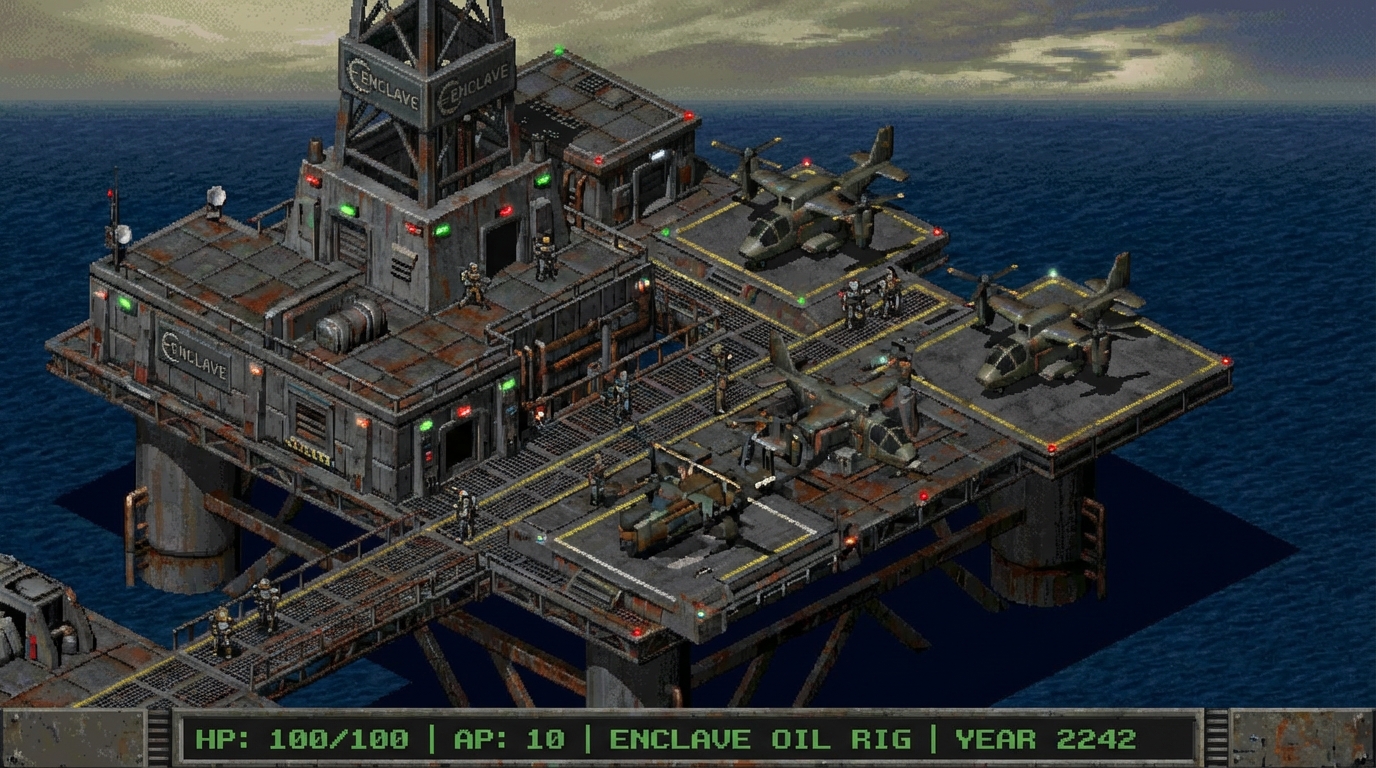
The Enclave's oil rig headquarters from Fallout 2

The Enclave's first major appearance came in 1998's Fallout 2, where they emerged as the game's primary antagonists. By 2241, the organization had established its headquarters on an offshore oil rig (Control Station ENCLAVE), where they had survived the nuclear apocalypse in relative comfort and safety. Unlike the wastelanders who struggled to survive in the irradiated ruins, the Enclave had preserved pre-war technology, knowledge, and—most importantly—their genetic "purity."

By 2140, the Enclave was united in a single vision: repopulate the Earth with 'pure' humans so America can rise again. What they deemed as 'pure' was someone without a hint of mutation, which essentially left most wastelanders out of this envisioned America. So the plan was to trigger a global genocide to 'clean' the world from its impurities, taking control of whatever is left.

Their plan was chillingly simple: deploy a modified strain of the Forced Evolutionary Virus (FEV) into the atmosphere, which would kill every living thing on Earth except those inoculated against it—namely, the Enclave themselves. This wasn't conquest; it was extermination on a planetary scale. The player character, the Chosen One, ultimately thwarts this plan by destroying the oil rig, dealing the Enclave its first major defeat.

Scientific Horrors

The Enclave was used to performing all sorts of biological experiments, since it was thanks to them that things like Super Mutants and Deathclaws even exist. Their scientists showed no ethical boundaries in their pursuit of military superiority. Deathclaws—the franchise's most terrifying predators—began as an Enclave bioweapon project. Even when these experiments went catastrophically wrong, creating monsters that threatened everyone including the Enclave themselves, the organization continued to view mutated life as nothing more than expendable test subjects.

Fallout 3: Raven Rock and the Capital Wasteland

Despite the destruction of their oil rig headquarters, the Enclave proved resilient. By the events of Fallout 3 in 2277, they had regrouped on the East Coast, establishing a new base of operations at Raven Rock in the Capital Wasteland. Here they introduced one of the franchise's most memorable villains: President John Henry Eden, who was later revealed to be an artificial intelligence rather than a human leader—a fact that added another layer of dystopian horror to their organization.

The Enclave in Fallout 3 maintained their genocidal ideology but adapted their methods. Rather than atmospheric deployment of FEV, they sought to control Project Purity—a water purification system that could provide clean water to the entire Capital Wasteland. Their plan was to poison this water supply with modified FEV, achieving their goal of exterminating all "mutated" humans (essentially everyone but themselves) through a resource the wasteland desperately needed.

Once again, the player character—this time the Lone Wanderer—stands against them. Major defeats due to external and internal factors effectively nullified the Enclave's technological advantage. By the end of the 23rd century, the Enclave lost all of its major hubs: The presidential oil rig, Raven Rock, Adams Air Force Base and Navarro. However, even without their homes, the Enclave remnants still possess their power armor, heavy weapons and vertibirds.

After Fallout 3, the Enclave seemed finished as a major power. They appeared only as scattered remnants in Fallout: New Vegas, where a small group of aging veterans could be recruited by the player. For years, it seemed the faction had been relegated to Fallout history.

Fallout 4: The Creation Club Tease

Fallout 4 launched in 2015 with virtually no Enclave presence, disappointing fans who had expected the faction to appear in the Commonwealth. However, Bethesda later added Enclave content through an unexpected avenue: the Creation Club.

It was largely absent in Fallout 4 (although later added as Creation Club content which is enabled by default in the first next-gen update) but returned in Fallout 76 as a joinable faction. The Fallout 4 quest Speak of the Devil started out as fan content, but has since made canon by including it for free in the April 2024 update. This is likely due to the designer of the quest, Kris Takahashi, being hired by Bethesda.

In 2287, an Enclave expedition appeared in the Commonwealth, led by Major Elias. Their orders were to establish a field headquarters in the Glowing Sea, in the derelict Atlantic Offices. This seemingly minor addition took on new significance when the Fallout TV series premiered, revealing that the Enclave had never truly been destroyed—they had simply been rebuilding in secret, waiting for the right moment to emerge from the shadows.

The fact that this content was made free and enabled by default in Fallout 4's next-gen update suggests deliberate coordination with the broader franchise narrative. Bethesda was planting seeds, establishing that Enclave remnants were active across multiple regions of post-war America.

The Fallout TV Series: Shadow Players Revealed

The Enclave's role in Amazon's Fallout series represents their most significant narrative expansion since Fallout 2. It appeared in a minor role in the Fallout TV series' first season, when Siggi Wilzig defects from the organization and sets the show's plot in motion, and takes on an expanded, overarching role in the latter half of the show's second season.

Season 1: The Scientist's Defection

While not one of the main antagonists of the first season, The Enclave did have a significant role in the development of the series. It was the Enclave that Dr. Siggi Wilzig, the scientist who saved canine unit CX404 and created the technology sought by every faction throughout the season, came from. Wilzig's defection and the cold fusion technology in his head set the entire season's plot in motion, though the Enclave themselves remained largely in the shadows.

According to Prime Video's Fallout series, the Enclave has since recovered. They were shown to have what appears to be a fully staffed base in an unspecified, snowy region somewhere in the United States. The existence of a functional Enclave base is a massive reveal, as it brings a fallen Fallout faction back from the dead.

Season 2: The Architects of Armageddon

Season 2 dramatically elevated the Enclave's importance to the franchise. Cooper Howard (Walton Goggins), hoping to avert nuclear war, hands over cold fusion to the President of the United States (Clancy Brown), secretly part of the Enclave. This revelation reframes the entire pre-war timeline: the Enclave wasn't just preparing for nuclear war—they were positioned at the highest levels of government when the bombs fell.

Fallout's season two finale confirmed a terrifying fact it had teased throughout the season: the Enclave was secretly controlling Vault-Tec before The Great War. And The Enclave is still the biggest player in the Wasteland today, with plans even more nefarious than we ever imagined. Yes, the Enclave is the major villain in the Fallout series, and it's just getting started.

The Phase 2 Message

Around the same time, Hank's wife and Vault 32 overseer Steph Harper successfully contacted the Enclave using an Enclave Pip-Boy stored away by Hank in Vault 33, in response to being cornered by angry Vault 32 dwellers who had discovered her past as a pre-War Canadian. Identifying herself as Hank's wife, Steph relayed Hank's instructions to report that the Enclave should initiate Phase Two, which was received by the Enclave at their Rocky Mountains facility. This also revealed that the Enclave members stationed there had been listening in to communications from all across the wasteland.

Hank MacLean (Kyle MacLachlan) confesses to his daughter Lucy that he has been working for the Enclave all this time and that the Wasteland is the true experiment. This confession reveals layers of deception stretching back centuries. The vaults, the experiments, even individual vault overseers like Hank—all pieces on the Enclave's chess board.

The Coming War

In Fallout season 2 episode 6, Ron Perlman's Super Mutant rescues the Ghoul from his hours-long impalement and brings him back to his lair. "There's a war coming, and we need you healthy," he says ominously. The Enclave's main goal is to wipe out anything that they deem less than human, including Ghouls and mutants, in order to preserve a race of "true humans" (as the Super Mutant explains to the Ghoul). They attempt an all-out genocide in Fallout 2 and go on a crusade in Fallout 76 that involves them unleashing a horrifying plague known as the Scorched Plague.

Evolution of Motivations: From Survival to Supremacy

Across the franchise, the Enclave's motivations have remained remarkably consistent, even as their circumstances changed. What evolves is not their ideology but their methods and justifications.

Pre-War: Shadow Government

Before 2077, the Enclave operated as a conspiracy within the conspiracy—a cabal of elites who believed they were saving humanity by preparing for inevitable nuclear conflict. They saw themselves as pragmatists making hard choices that weaker leaders couldn't stomach. Their involvement with Vault-Tec's experiments suggests they viewed ordinary Americans as test subjects rather than citizens to protect.

Post-War: Genetic Fascism

After the bombs fell, the Enclave's elitism calcified into full-blown genetic fascism. Having survived in controlled environments, they emerged viewing themselves as humanity's rightful inheritors—genetically pure, technologically advanced, and morally justified in exterminating anyone who didn't meet their standards. This wasn't just about rebuilding America; it was about creating a new America that excluded 99.9% of survivors.

Modern Era: The Long Game

The TV series reveals that the Enclave has been playing a game measured in centuries rather than decades. In Fallout season two, Hank had been working in the secret Enclave vault, perfecting miniaturization of the mind-control device Robert House had traded with Vault-Tec years before The Great War. Hank succeeded. And not just at shrinking the tech. He told Lucy his new R&D was already out in the wasteland. No one will even know who out there is automated and who isn't because the device is so small. But even more terrifying is that those unwitting soldiers—with personalities shaped by sweet, good-hearted Congresswoman Diane Welch's (thankfully now dead) head—are carrying out orders. They're orders, Hank says, that were written centuries before.

This represents a chilling evolution: the Enclave no longer needs to openly conquer or exterminate. They can simply control, manipulate, and direct events from the shadows while the wasteland's various factions believe they're acting of their own free will.

The Enclave Across Media: A Franchise Cornerstone

Fallout 2 (1998)

First appearance as primary antagonists. Oil rig headquarters, genocidal FEV plan, and establishment of their core ideology. Destroyed by the Chosen One.

Fallout 3 (2008)

Return in the Capital Wasteland. Raven Rock base, President Eden AI, Project Purity poisoning plot. Major defeat at Adams Air Force Base.

Fallout: New Vegas (2010)

Appear as aging remnants. A small group of veterans can be recruited, showing the faction's decline after their defeats.

Fallout 76 (2018)

Players can join the Appalachian Enclave and interact with MODUS, an AI controlling the Congressional Bunker. First time players can side with the faction.

Fallout 4 Creation Club (2024)

Free official content added showing Enclave expedition in the Commonwealth's Glowing Sea, establishing their continued presence.

Fallout TV Series Season 1 (2024)

Dr. Wilzig's defection reveals a functional Enclave base in the Rocky Mountains with advanced cold fusion research.

Fallout TV Series Season 2 (2026)

Revealed as the shadowy force controlling Vault-Tec and potentially orchestrating the Great War itself. Phase 2 initiated.

The Enclave was considered by Screen Rant as the most evil faction in the Fallout universe. This designation isn't hyperbole. While other factions commit atrocities in pursuit of flawed ideologies or misguided goals, the Enclave's evil is systematic, calculated, and genocidal. They don't just want to rule the wasteland—they want to eliminate everyone in it and start fresh.

What's Next? Predictions for Season 3 and Beyond

Though it looks like it won't be fully revealed until episode 7 or 8, the Enclave is the big bad that's been lurking in the shadows all along. The Super Mutant does say that a war involving the Enclave is coming, and it's likely that this will unite all of the factions in some epic way.

🎯 The Super Mutant Uprising

As the Enclave wants to wipe out mutants, it makes sense that the show would be setting up a dark war between the two groups. Both sides are now gaining momentum, and it could signal the endgame for the show. This war could also go as far as to affect the story of Fallout 5 and other future updates to Fallout 76.

The Alliance of Necessity

Now that the Enclave has been unveiled, and they appear to be very active in the post-apocalypse, with communications from Hank MacLean and Steph Harper proving they are controlling things from a distance, it seems inevitable that they will be back in Fallout season 3 and beyond.

Season 3 will likely force unlikely alliances. The Brotherhood of Steel, despite their authoritarian tendencies, oppose the Enclave's genocidal ideology. The Super Mutants, created by the Enclave and now targeted for extermination, have every reason to fight back. Even figures like Cooper Howard (The Ghoul), who has survived 200 years of wasteland violence, may find common cause with his former enemies against the organization that orchestrated the apocalypse.

Phase 2: The Unknown Variable

What exactly is "Phase 2" that Steph Harper activated? The show has deliberately kept this mysterious, but several possibilities emerge from the established lore:

The Brotherhood's Role

This would also give Maximus and the Brotherhood a new enemy to combat, as the two factions have been longtime enemies since the world's end. With the Brotherhood now possessing the technology, Dr. Wilzig developed and used to bring cold-fusion power to life, a battle between the Brotherhood and the Enclave could significantly develop Maximus's story.

The cold fusion technology that drove Season 1's plot now sits with the Brotherhood of Steel. This makes them both the Enclave's primary target and potentially humanity's best hope against the shadow government's machinations. Expect Season 3 to feature a technological arms race, with both factions leveraging pre-war science to devastating effect.

Lucy's Journey: From Idealist to Revolutionary

Lucy MacLean began the series as a naive vault dweller who believed in the fundamental goodness of Vault-Tec and the vaults' mission. She's since learned that her father is an Enclave operative, that her entire existence was part of a centuries-long experiment, and that the organization responsible for saving humanity in the vaults is the same one that destroyed the world.

Season 3 will likely complete her transformation from innocent idealist to hardened resistance fighter. Her unique position—as someone who understands both vault culture and wasteland reality, who has personal connections to both the Enclave (through Hank) and its victims—makes her the perfect symbol for a united resistance.

🔮 Cross-Media Synergy

The Enclave is now officially the most powerful force in the Wasteland again, and it spells doom for Lucy, Maximus, and The Ghoul in all future seasons of the show. This resurgence will likely influence future Fallout games as well. Expect Fallout 5 (whenever it arrives) to incorporate the TV series' lore about the Enclave's continued existence and their role in orchestrating the Great War.

The Question of Redemption

One fascinating possibility the show could explore: can the Enclave be redeemed, or are they irredeemably evil? Individual members like Dr. Wilzig have defected, suggesting that not everyone in the organization agrees with its genocidal mission. We might see a schism within the Enclave itself—between hardliners who maintain the old ideology and reformists who recognize that genetic purity is a dead-end philosophy in a world where everyone carries trace radiation.

However, given the Enclave's track record across the franchise, redemption seems unlikely. More probable is a scenario where individual defectors aid the resistance while the organization as a whole must be destroyed to secure the wasteland's future.
Why the Enclave Matters: Themes and Relevance

The Enclave's enduring presence across the Fallout franchise isn't just about having a memorable villain. They embody several themes that make them remarkably relevant to contemporary audiences.

The Dangers of Elitism

The Enclave represents what happens when a society's elite decide they're fundamentally different from—and superior to—ordinary people. Their genetic purity obsession is a dark mirror of real-world eugenics movements, showing how pseudo-scientific justifications can rationalize atrocities. In viewing themselves as humanity's rightful inheritors, they deny the humanity of everyone else.

Conspiracy and Control

The revelation that the Enclave controlled Vault-Tec—that the organization promising salvation was working for the one planning annihilation—speaks to anxieties about shadowy power structures manipulating society from behind the scenes. The Enclave's ability to listen to all wasteland communications, to plant sleeper agents, to orchestrate events across centuries, makes them a paranoia made flesh.

The Myth of Purity

In a post-apocalyptic world where everyone and everything carries the scars of nuclear war, the Enclave's obsession with genetic purity is both their defining characteristic and their fatal flaw. They fail to recognize that adaptation and mutation aren't weaknesses but survival mechanisms. Their ideology demands they reject the very changes that allowed humanity to survive.

Technological Supremacy vs. Human Survival

The Enclave has the best technology, the most advanced weapons, superior resources—yet they consistently lose to scrappier opponents who have what they lack: adaptability, community, and a willingness to change. This speaks to a core Fallout theme: that human resilience and cooperation matter more than technological advantage.

"Robert House is right. So long as the Enclave endures, 'there is no safety.' Not for anyone anywhere. And that's been true for a long time."

Conclusion: The Enclave's Enduring Legacy

From their introduction as Fallout 2's genocidal antagonists to their role as the TV series' ultimate puppet masters, the Enclave has evolved from a faction into a franchise-defining element. They represent the darkest aspects of pre-war America—its elitism, its hubris, its willingness to sacrifice the many for the benefit of the few—amplified and distorted into post-apocalyptic fascism.

It now appears to have been confirmed that the Enclave were indeed the architects of the apocalypse. It implies that the Great War was the result of long-term manipulation by the Enclave, who are a secretive remnant of the pre-war US government. Through revelations tied to Hank MacLean and Stephanie Harper, the Enclave are positioned as the faction that shaped the political, technological and ideological conditions that made nuclear annihilation inevitable.

This revelation fundamentally changes how we understand the Fallout universe. The nuclear apocalypse wasn't an accident, a moment of mutual miscalculation, or even simple greed. It was orchestrated—a controlled demolition of civilization by elites who believed they could survive, thrive, and rebuild in their image.

As the franchise moves forward, the Enclave stands as its central villain not because they're the strongest or most technologically advanced, but because they embody everything the wasteland represents a rejection of: the old world's sins, its inequalities, its failures. Every survivor who builds a settlement, every faction that tries to create something better than what came before, every wastelander who chooses cooperation over domination is implicitly fighting against what the Enclave represents.

But with one of the most notable factions in the Wasteland undergoing a major shift in the show, Fallout is breaking new ground and could soon be rewriting the story that appears in future games. The TV series has elevated the Enclave from defeated remnants to active threat, setting the stage for what could be the faction's final confrontation across all Fallout media.

The war is coming. The wasteland's factions are mobilizing. And somewhere in a Rocky Mountain facility, the Enclave listens, watches, and prepares to execute plans written before the bombs fell. The question isn't whether the Enclave can be stopped—the franchise history shows they can be defeated. The question is what price the wasteland will pay before they finally fall.

In the end, the Enclave's greatest legacy may be forcing the wasteland's disparate factions to recognize a fundamental truth: that the old world died for a reason, and anyone trying to resurrect it—especially in its most toxic form—must be opposed, no matter the cost.