A Holiday Shaped by Centuries
Christmas, celebrated annually on December 25, is a sacred religious holiday as well as a worldwide cultural and commercial phenomenon. For roughly two millennia, people around the world have been observing it with traditions and practices that are both religious and secular in nature.
Despite the religious importance of Christmas, few if any of the contemporary Christmas customs have their origin in theological or liturgical affirmations, and most are of fairly recent date. The Christmas we celebrate today is remarkably different from how it was observed throughout most of history.
Ancient Roots: Before Christmas
The end of December was a perfect time for celebration in most areas of Europe. At that time of year, most cattle were slaughtered so they would not have to be fed during the winter. For many, it was the only time of year when they had a supply of fresh meat. In addition, most wine and beer made during the year were finally fermented and ready for drinking.
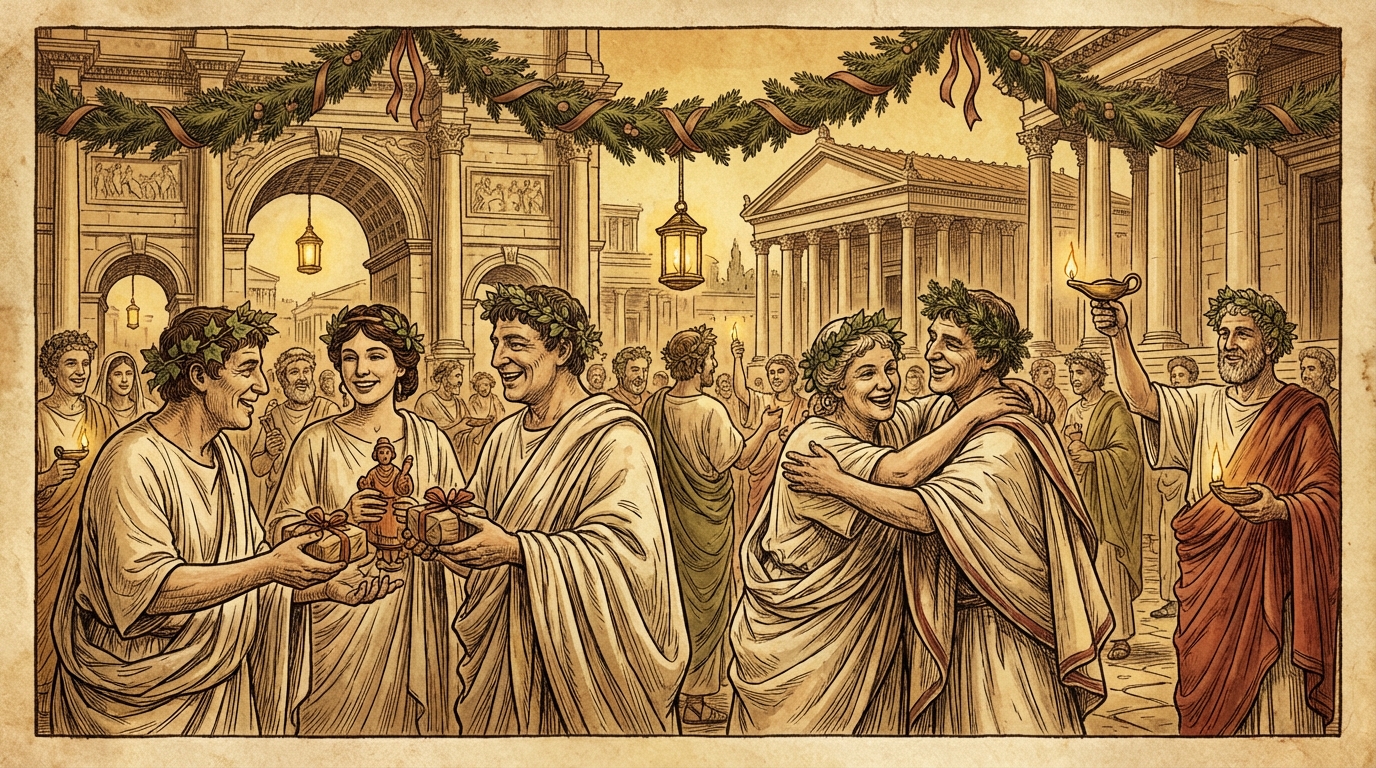
Saturnalia: Rome's Winter Festival
In Rome, where winters were not as harsh as those in the far north, people celebrated Saturnalia in honor of Saturn, the god of agriculture. Beginning in the week leading up to the winter solstice and continuing for a full month, Saturnalia was a hedonistic time, when food and drink were plentiful and the normal Roman social order was turned upside down. For a month, enslaved people were given temporary freedom and treated as equals. Business and schools were closed so that everyone could participate in the holiday's festivities.
Yule: Germanic Winter Traditions
The pre-Christian Germanic peoples—including the Anglo-Saxons and the Norse—celebrated a winter festival called Yule, held in the late December to early January period, yielding modern English yule, today used as a synonym for Christmas. In Germany, people honored the pagan god Odin during the mid-winter holiday. Germans were terrified of Odin, as they believed he made nocturnal flights through the sky to observe his people and then decide who would prosper or perish.
The Birth of Christmas: 4th Century AD
The early Christian community distinguished between the identification of the date of Jesus' birth and the liturgical celebration of that event. The actual observance of the day of Jesus' birth was long in coming. In particular, during the first two centuries of Christianity there was strong opposition to recognizing birthdays of martyrs or, for that matter, of Jesus. Numerous Church Fathers offered sarcastic comments about the pagan custom of celebrating birthdays.
336 AD
First Recorded Christmas
Dec 25
Date Officially Set
1870
US Federal Holiday
It was not until 336, during the reign of the emperor Constantine, that the church in Rome began formally celebrating Christmas on December 25. Liturgical historians generally agree that this part of the text was written in Rome in AD 336.
Why December 25?
In the 3rd century the Roman Christian historian Sextus Julius Africanus dated Jesus' conception to March 25 (the Annunciation), which, after nine months in his mother's womb, would result in a December 25 birth. As Constantine had made Christianity the effective religion of the empire, some have speculated that choosing this date had the political motive of weakening established pagan celebrations.
Then vs. Now: How Christmas Celebrations Changed
The prevailing atmosphere of Christmas has also continually evolved since the holiday's inception, ranging from a sometimes raucous, drunken, carnival-like state in the Middle Ages, to a tamer family-oriented and children-centered theme introduced in a 19th-century transformation.
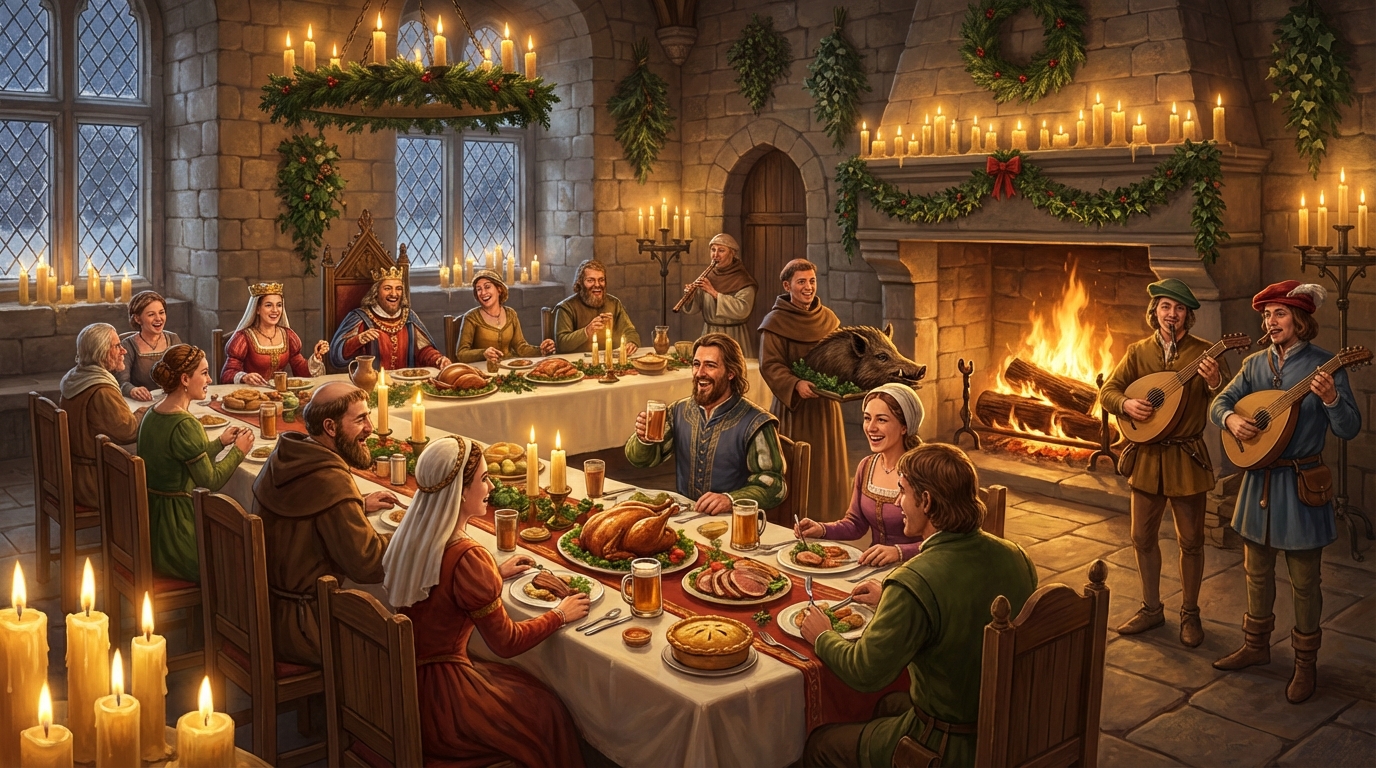
Medieval Christmas (500-1500 AD)
- Christmas was a 12-day-long festival involving all kinds of revelry
- "Misrule"—drunkenness, promiscuity, gambling—was also an important aspect of the festival
- The most extravagant feasts were celebrated by monarchs such as Henry III, whose guests gorged themselves on 600 oxen at one 13th-century Christmas feast
- In England, gifts were exchanged on New Year's Day (a custom at the royal court)
- Christmas celebrations carried on for multiple raucous days and nights
Colonial America (1600s-1700s)
- The Puritans of New England disapproved of Christmas celebrations as wasteful and immoral. It was associated with Paganism and the decadence of Catholicism.
- People did exchange gifts but it was not considered crucial. In fact, most of what we would recognize as key points of Christmas were not around or were not practiced by a majority of Americans.
- The only people who had Christmas trees were Germans and other groups viewed it as very odd.
- The focus of the holiday at the time was Jesus and parties.
Victorian Era (1800s)
- The 19th century saw huge changes to Christmas. This is the period where the holiday became more recognizable to modern eyes.
- Most importantly though this is when the focus of Christmas changed. Before the holiday rarely focused on the home, it was in large part full of public or semi-public social activities, namely parties with copious amounts of alcohol.
- The family unit was also becoming less disciplined and more sensitive to the emotional needs of children during the early 1800s. Christmas provided families with a day when they could lavish attention and gifts on their children without appearing to "spoil" them.
- The tradition of Christmas cards, as we know them, began in this period. The first true Christmas card was designed by J.C. Horsley in 1843.
Modern Christmas (1900s-Today)
- In 2019, more than nine in ten Americans polled by Gallup said they celebrate Christmas—but just 35 percent said they saw the holiday as "strongly religious."
- Christmas was traditionally a Christian festival celebrating the birth of Jesus, but in the early 20th century it also became a secular family holiday, observed by Christians and non-Christians alike. The secular holiday is often devoid of Christian elements, with the mythical figure Santa Claus playing the pivotal role.
- Today, it's one of America's most extravagant and popular holidays with almost 90% of Americans saying they celebrate.
- Though Christmas has religious origins, it's become a secular—and increasingly commercialized—holiday. "People have complained about the excessive commercialization of Christmas ever since its [modern] incarnation in the mid-19th century."

The Pivotal 19th Century Transformation
The 19th century marked the most significant shift in how Christmas was celebrated, transforming it from a public, often rowdy festival into the intimate family celebration we know today.
Cultural Influences That Shaped Modern Christmas
Washington Irving & Charles Dickens
During conflict between classes, Washington Irving wrote The Sketch Book of Geoffrey Crayon, gent., a series of stories about the celebration of Christmas. The stories featured a wealthy man who invited peasants into his home for the holiday. This created the idea that Christmas should be a warm holiday that brings all classes together.
Also around this time, English author Charles Dickens created the classic holiday tale, A Christmas Carol. The story's message about the importance of charity and goodwill toward all humankind struck a powerful chord in the United States and England and showed members of Victorian society the benefits of celebrating the holiday.
Immigration and Cultural Blending
As Americans began to embrace Christmas as a perfect family holiday, old customs were unearthed. People looked to recent immigrants and Catholic and Episcopalian churches to see how the day should be celebrated. Other immigrants arriving from Europe continued with the customs of their homelands. The Dutch brought Sinter Klaas with them to New York in the 1600's. The Germans brought their tree traditions in the 1700's.
As Christmas historian William D. Crump writes in The Christmas Encyclopedia, this created "a kind of Christmas melting pot, with assimilation of various cultures into a more uniform and widely celebrated holiday at home with the family."
Christmas Around the World
With the spread of Christianity beyond Europe and North America, the celebration of Christmas was transferred to societies throughout the non-Western world. In many of these countries, Christians are not the majority population, and, therefore, the religious holiday has not become a cultural holiday. Christmas customs in these societies thus often echo Western traditions because the people were exposed to Christianity as a religion and cultural artifact of the West.
Unexpected Places That Celebrate Christmas
Countries such as Japan, where Christmas is popular despite there being only a small number of Christians, have adopted many of the cultural aspects of Christmas, such as gift-giving, decorations, and Christmas trees. A similar example is in Turkey, being Muslim-majority and with a small number of Christians, where Christmas trees and decorations tend to line public streets during the festival.
Different Dates for Different Traditions
Part of the Eastern Christian Churches celebrate Christmas on December 25 of the older Julian calendar, which currently corresponds to January 7 in the Gregorian calendar. This means millions of Orthodox Christians celebrate Christmas on what the Western calendar recognizes as January 7th.
A Living Tradition
Christmas has proven to be one of the most adaptable and enduring celebrations in human history. From its ancient roots in pagan winter festivals, through its Christian religious significance, to its modern secular celebration, Christmas has continuously evolved while maintaining its core spirit of gathering, giving, and celebrating light in the darkest time of year.
The customs associated with Christmas in various countries have a mix of pre-Christian, Christian, and secular themes and origins. This remarkable blend of traditions from different cultures and eras has created a holiday that resonates with billions of people worldwide, regardless of their religious beliefs.
The Christmas celebrated today—with decorated trees, gift-giving, family gatherings, and Santa Claus—would be nearly unrecognizable to Christians of the early centuries or even to Americans of the colonial era. Yet the fundamental human desire to celebrate hope, light, and community during winter's darkness remains constant across the millennia.
2,000+
Years of Christmas History
90%
Of Americans Celebrate
Billions
Celebrate Worldwide