Model Context Protocol (MCP)

The Universal Language for AI Agents to Connect with Tools and Data

Discover how MCP enables AI agents to seamlessly interact with databases, APIs, file systems, and external services through a standardized protocol

What is MCP? The Protocol That Unlocks AI Agent Potential

Imagine giving an AI agent the ability to not just talk, but to act—to query databases, read files, call APIs, browse the web, and execute code. Model Context Protocol (MCP) makes this possible by providing a standardized, open protocol that connects AI agents to external tools and data sources.

Before MCP, every AI application needed custom integration code for each tool or data source. Want your agent to access a database? Write a custom connector. Need it to read from a file system? Build another integration. This resulted in fragmented, non-reusable code and severely limited what AI agents could accomplish.

MCP solves this by establishing a universal client-server protocol where AI agents (clients) can discover and invoke capabilities exposed by MCP servers. Think of it as USB for AI agents—one standardized interface that works with countless tools and services.
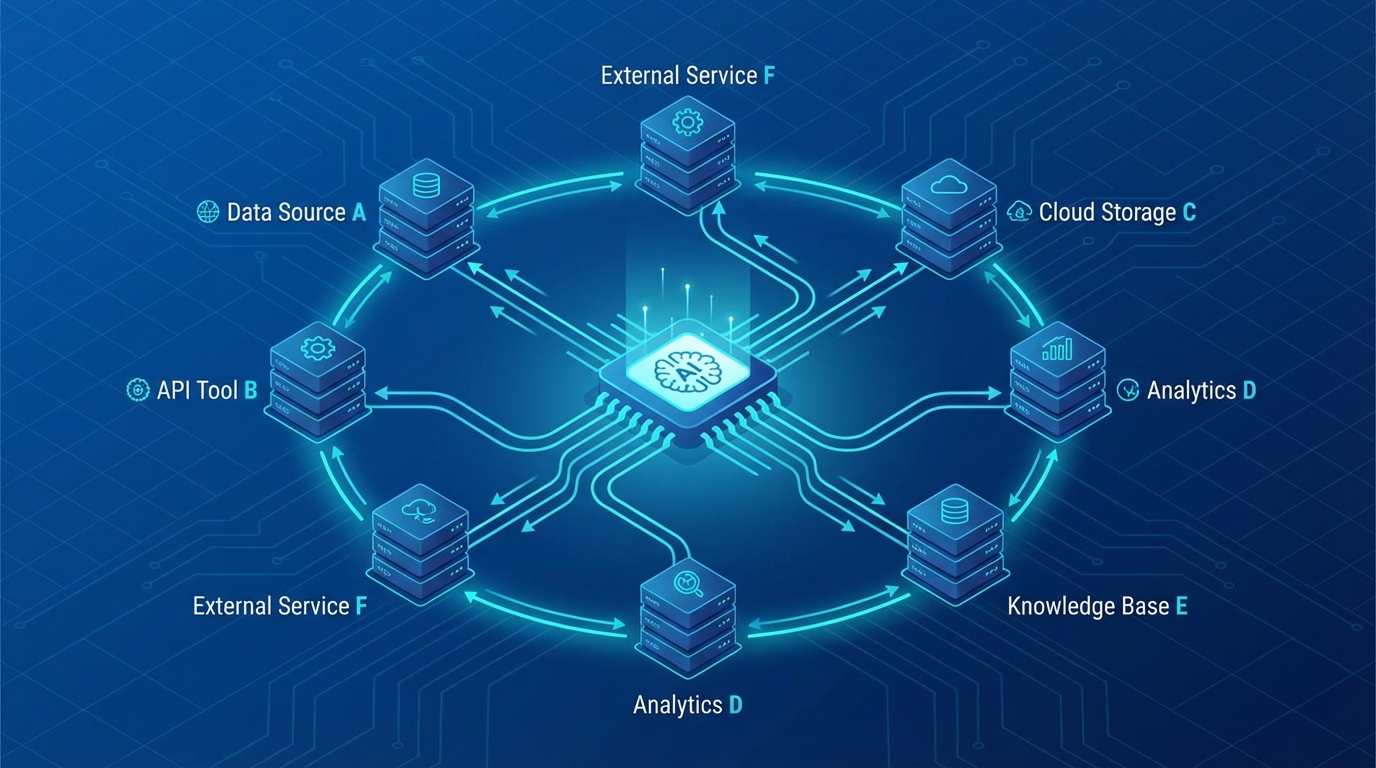
MCP architecture diagram showing AI agent connected to multiple servers

How MCP Connects Agents to Servers

🤖
💾
Database
📁
File System
🌐
Web API
🔧
Tools

The AI agent (center) communicates with multiple MCP servers through standardized connections, exchanging data packets in real-time.
The Three Core Primitives of MCP

MCP is elegantly simple, built on three fundamental concepts that enable powerful AI agent interactions:

🔧

Tools (Functions)

Tools are functions that agents can invoke to perform actions. An MCP server exposes a set of tools with defined schemas (inputs and outputs). When an agent needs to execute an action—like querying a database or sending an email—it calls the appropriate tool through MCP.

Example tools: query_database(), read_file(), send_email()

📚

Resources (Context)

Resources represent data or context that agents can read. These could be files, database records, API responses, or any information the agent needs to understand the environment. Resources provide the context that makes agent responses relevant and informed.

Example resources: documents, configuration files, knowledge bases

💬

Prompts (Templates)

Prompts are reusable templates that structure how agents interact with tools and resources. They provide predefined workflows and instructions that ensure consistent, effective agent behavior across different scenarios.

Example: A prompt template for "analyze this codebase" that guides the agent through code review steps

How MCP Actually Works: The Protocol Flow

MCP operates as a stateful, session-based protocol using JSON-RPC 2.0 for message exchange. Here's what happens when an AI agent interacts with an MCP server:

1

Initialization & Capability Discovery

The client (AI agent) connects to an MCP server and sends an initialize request. The server responds with its capabilities: which tools, resources, and prompts it provides. This is like a handshake where both parties agree on what's possible.

2

Tool/Resource Discovery

The agent requests detailed information about available tools using tools/list or resources using resources/list. The server returns schemas defining inputs, outputs, and descriptions for each capability.

3

Invocation

The agent decides which tool to call based on its task, then sends a tools/call request with the tool name and arguments. For example: {"tool": "query_database", "arguments": {"query": "SELECT * FROM users"}}

4

Execution & Response

The MCP server executes the requested operation (e.g., runs the database query) and returns the results to the agent. The agent receives structured data it can reason about and use to continue its task.

5

Iteration

The agent can continue invoking tools, reading resources, and gathering context in a multi-turn conversation with the MCP server until the task is complete. The session maintains state throughout.

// Example MCP tool invocation message (JSON-RPC 2.0) { "jsonrpc": "2.0", "id": 1, "method": "tools/call", "params": { "name": "query_database", "arguments": { "query": "SELECT name, email FROM users WHERE active = true", "database": "production" } } } // Server response { "jsonrpc": "2.0", "id": 1, "result": { "content": [ { "type": "text", "text": "[{\"name\": \"Alice\", \"email\": \"alice@example.com\"}, ...]" } ] } }

Why MCP Matters: The Paradigm Shift for AI Agents

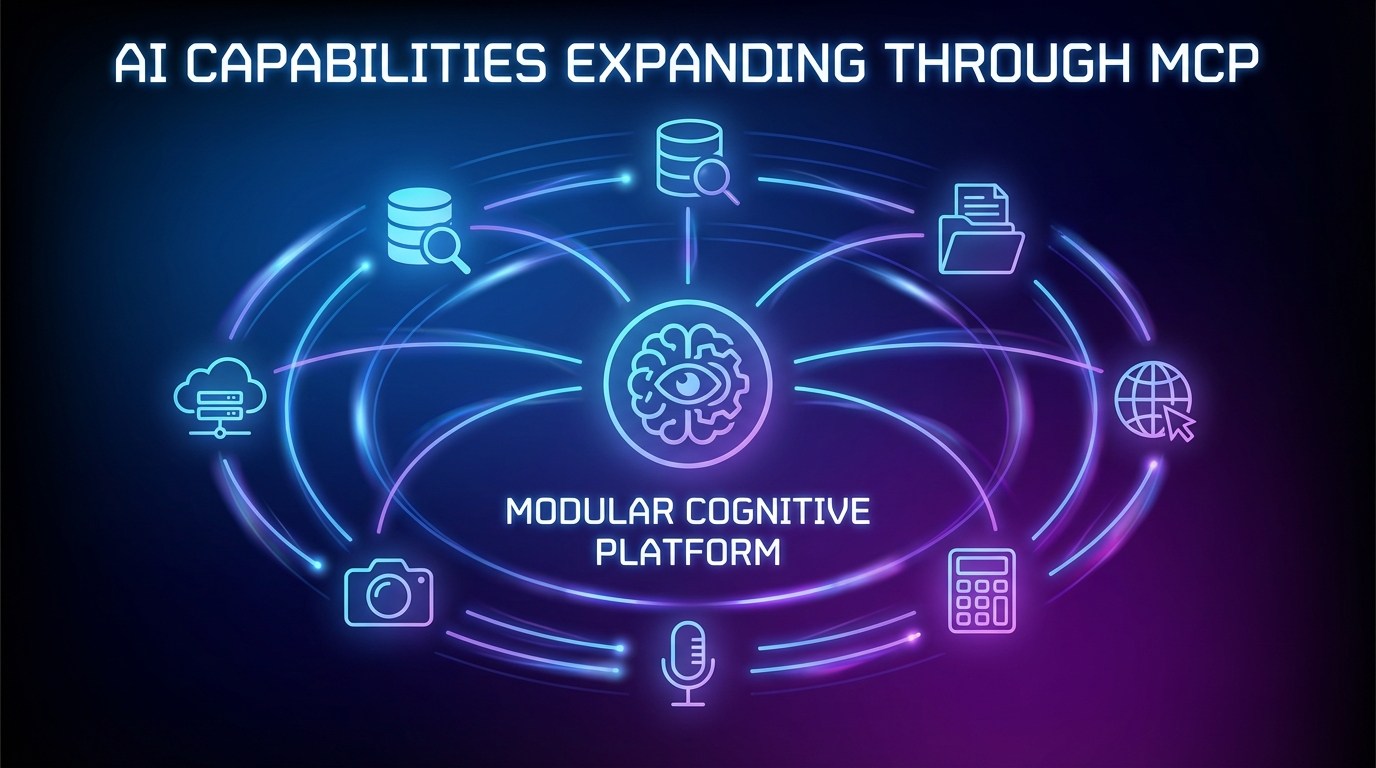
AI agent capabilities expanding through MCP tool connections

MCP represents a fundamental shift in how we architect AI systems. Instead of building monolithic agents with hardcoded capabilities, we now have a composable, modular ecosystem where agents can dynamically connect to any MCP-compatible server.

Interoperability Across the AI Ecosystem

The most profound impact of MCP is interoperability. Just as HTTP enabled the internet to flourish by providing a common protocol for web communication, MCP enables an ecosystem of AI tools and services that work together seamlessly. A developer can build an MCP server once, and it becomes immediately usable by any MCP-compatible AI agent—whether that's Claude, GPT-4, or a custom agent you build yourself.

This eliminates the "N×M problem" where N different AI frameworks each need M custom integrations. With MCP, you write one server implementation, and it works everywhere.

Security and Control

MCP includes robust security features essential for production deployments. Servers can implement fine-grained permission systems, control which tools are exposed to which agents, and audit all interactions. The protocol supports authentication, authorization, and encrypted communication channels.

This is critical because agents often need access to sensitive data and powerful operations. MCP ensures these interactions happen within well-defined security boundaries.

Context Window Management

One subtle but powerful advantage: MCP helps manage the agent's limited context window. Instead of loading entire databases or file systems into the agent's prompt, resources are fetched on-demand as needed. The agent can request "show me the user schema" without consuming context space with data it doesn't need yet.

Composability and Specialization

MCP encourages building specialized servers that do one thing extremely well. A database MCP server focuses solely on database operations. A file system server handles files. A web search server manages searches. Agents compose these capabilities together to accomplish complex tasks, much like Unix pipes compose simple command-line tools.

MCP vs. Traditional Integration Approaches

Aspect Traditional Custom Integration MCP Protocol
Reusability Write custom code for each AI framework Write once, works with all MCP clients
Discovery Static, hardcoded capabilities Dynamic capability discovery at runtime
Standardization Each integration uses different patterns Consistent JSON-RPC protocol everywhere
Security Security implemented inconsistently Built-in authentication and authorization
Maintenance Update each integration separately Update server once, all clients benefit
Ecosystem Siloed, incompatible implementations Open ecosystem of interoperable servers

The comparison is stark: traditional approaches create fragmentation and duplication of effort, while MCP creates a unified ecosystem that benefits everyone. As more developers adopt MCP, the network effects compound—each new MCP server adds value to every MCP-compatible agent.

Real-World Use Cases: What MCP Enables

MCP opens up categories of AI applications that were previously impractical or too expensive to build. Here are concrete examples of what becomes possible:

1. AI-Powered Development Environments

An AI coding assistant that can read your codebase, execute tests, query your git history, search documentation, and make commits—all through standardized MCP servers. The assistant doesn't need custom integration with each IDE or version control system; it just connects to MCP servers that expose these capabilities.

2. Enterprise Data Analysis Agents

An agent that helps business analysts by querying multiple databases (SQL, MongoDB, Elasticsearch), pulling data from internal APIs, cross-referencing with CRM systems, and generating reports. Each data source provides an MCP server, and the agent orchestrates complex multi-step analyses by composing these tools.

3. Customer Support Automation

A support agent that can search knowledge bases, query order databases, check inventory systems, send emails, and escalate to humans when needed. MCP servers wrap each backend system, and the agent decides which tools to invoke based on the customer's question.

4. Research and Knowledge Synthesis

An AI researcher that can search academic databases, read PDFs from your local file system, query Wikipedia, execute Python scripts for calculations, and save findings to a structured database. Each capability is provided by a different MCP server, but the agent seamlessly combines them.

5. DevOps and Infrastructure Management

An agent that monitors system health, queries metrics databases, reads log files, executes diagnostic commands, and can even trigger automated remediation workflows. MCP servers provide controlled access to production systems with full audit trails of agent actions.

What unifies all these examples is the composition of capabilities. MCP doesn't just enable simple one-off tool calls; it enables agents to orchestrate complex, multi-step workflows that span different systems and data sources.

Building with MCP: The Developer Experience

One of MCP's greatest strengths is how approachable it is for developers. The protocol is simple enough to implement from scratch, but there are also official SDKs that handle the complexities.

Creating an MCP Server

Building an MCP server involves three main steps:

// Example: Simple MCP server in TypeScript (conceptual) import { MCPServer } from '@modelcontextprotocol/sdk'; const server = new MCPServer({ name: 'my-database-server', version: '1.0.0' }); // Register a tool server.registerTool({ name: 'query_users', description: 'Query the users database', inputSchema: { type: 'object', properties: { filter: { type: 'string', description: 'SQL WHERE clause' } } }, handler: async (params) => { const results = await db.query(`SELECT * FROM users WHERE ${params.filter}`); return { content: [{ type: 'text', text: JSON.stringify(results) }] }; } }); // Register a resource server.registerResource({ uri: 'database://schema/users', name: 'Users Table Schema', mimeType: 'application/json', handler: async () => { const schema = await db.getSchema('users'); return { content: [{ type: 'text', text: JSON.stringify(schema) }] }; } }); server.start();

The server defines what it can do (tools), what information it provides (resources), and how to execute those capabilities. The MCP SDK handles all protocol details—message routing, capability negotiation, error handling.

Connecting an Agent to MCP Servers

On the client side, AI applications connect to MCP servers and automatically gain access to their capabilities. Many modern AI frameworks are adding native MCP support, making it as simple as configuring a connection URL.

The MCP Inspector

A critical developer tool is the MCP Inspector—a debugging interface that lets you explore what tools and resources a server provides, manually invoke tools, and inspect the protocol messages being exchanged. This dramatically speeds up development and troubleshooting.

The Future of MCP: An Open Ecosystem

MCP is an open standard, which means its future is shaped by the community of developers building with it. Several trends are emerging:

A Marketplace of Capabilities

Imagine a future where developers publish MCP servers to a registry, similar to npm for JavaScript or PyPI for Python. Need to add web search to your agent? Just connect to a web search MCP server. Need database access? Add a database server. This creates a thriving ecosystem where capabilities become modular, reusable components.

Cross-Platform Agent Mobility

Because MCP is protocol-level, not tied to any specific AI model or framework, agents become more portable. A workflow built with Claude today could run with a different model tomorrow, as long as both support MCP. This reduces vendor lock-in and encourages innovation.

Specialized Domain Servers

We're seeing the emergence of domain-specific MCP servers—finance servers that understand trading APIs, healthcare servers that navigate medical record systems, legal servers that query case law databases. These specialized servers encode domain expertise that any agent can leverage.

Enterprise Adoption

Large organizations are beginning to standardize on MCP as their internal protocol for AI agent integrations. This creates a unified approach to AI governance, security, and capability management across the enterprise.

The trajectory is clear: MCP is becoming the lingua franca for AI agent interactions, much like how HTTP became the foundation of the web. As the protocol matures and the ecosystem grows, the possibilities for what AI agents can accomplish will expand dramatically.

Key Takeaways

🎯 Universal Protocol

MCP provides a single, standardized way for AI agents to connect with tools and data sources, eliminating the need for custom integrations.

🔧 Three Primitives

Built on tools (actions), resources (context), and prompts (templates), MCP keeps complexity low while enabling powerful capabilities.

🌐 Open Ecosystem

As an open standard, MCP creates an interoperable ecosystem where any server works with any client, encouraging innovation and collaboration.

🔒 Security Built-In

MCP includes authentication, authorization, and audit capabilities essential for production AI deployments.

🚀 Composable Capabilities

Agents can combine multiple MCP servers to accomplish complex, multi-step tasks that span different systems and data sources.

📈 Network Effects

Each new MCP server adds value to every compatible agent, creating compounding benefits as the ecosystem grows.

Model Context Protocol isn't just a technical specification—it's the foundation for a new generation of AI agents that can truly act in the world, not just talk about it.