The Controversial Debate Over Interstellar Visitors
Two mysterious objects from beyond our solar system have sparked fierce scientific debate. Are they natural comets and asteroids, or could they be evidence of extraterrestrial technology?
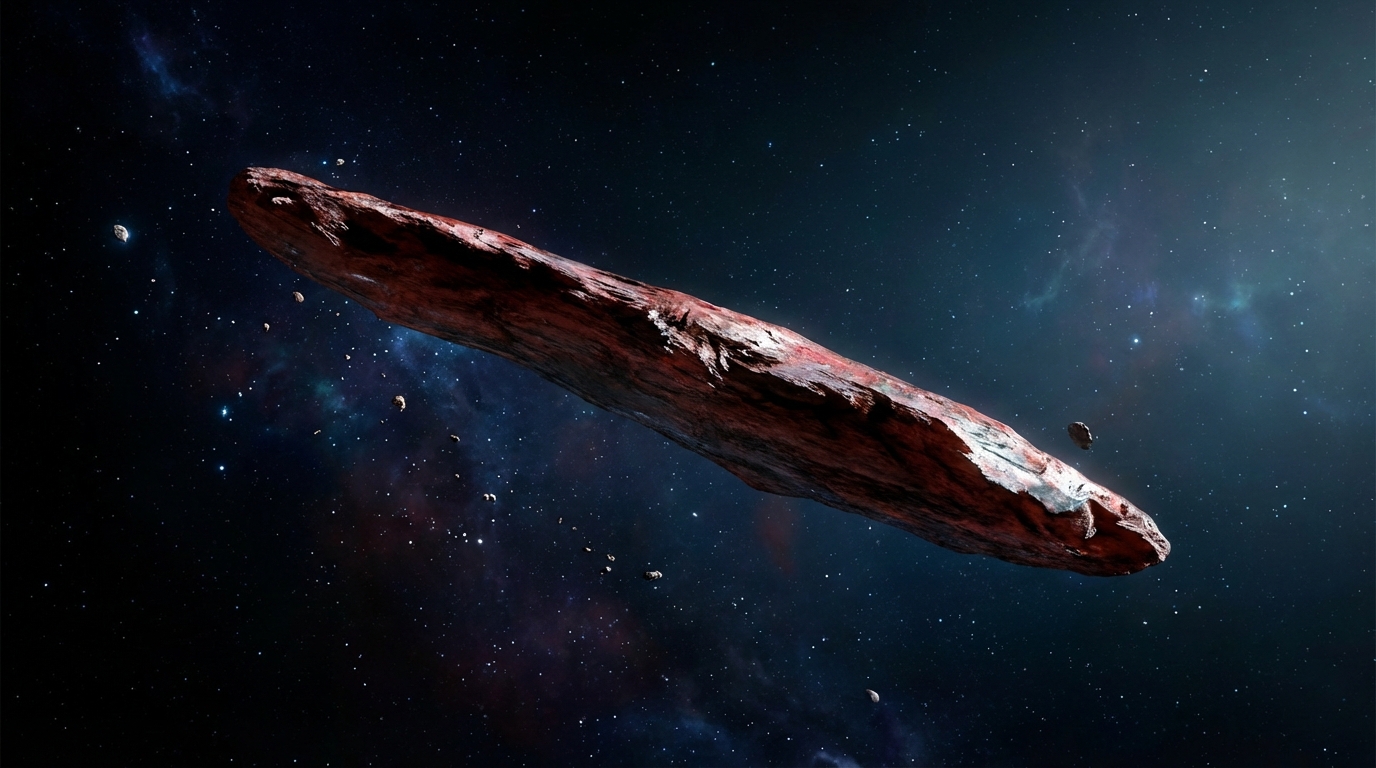
Artist's impression of 'Oumuamua, the first confirmed interstellar object to visit our solar system
In October 2017, astronomers discovered 1I/'Oumuamua, the first confirmed interstellar object detected passing through the Solar System, using the Pan-STARRS telescope at Haleakalā Observatory, Hawaii. The object was unusual in almost every way—its elongated shape, reddish color, and most perplexingly, its unexpected acceleration as it left the solar system.
Eight years later, on July 1, 2025, the Asteroid Terrestrial-impact Last Alert System (ATLAS) discovered 3I/ATLAS, the third confirmed interstellar object passing through the Solar System. Once again, Harvard astronomer Avi Loeb has suggested that these objects may not be natural—but could instead be extraterrestrial spacecraft.
Unlike comets and asteroids born in our solar system, interstellar objects come from other star systems, traveling through the galaxy for millions or billions of years before passing through our cosmic neighborhood. We've only confirmed three such visitors: 'Oumuamua (2017), 2I/Borisov (2019), and 3I/ATLAS (2025).
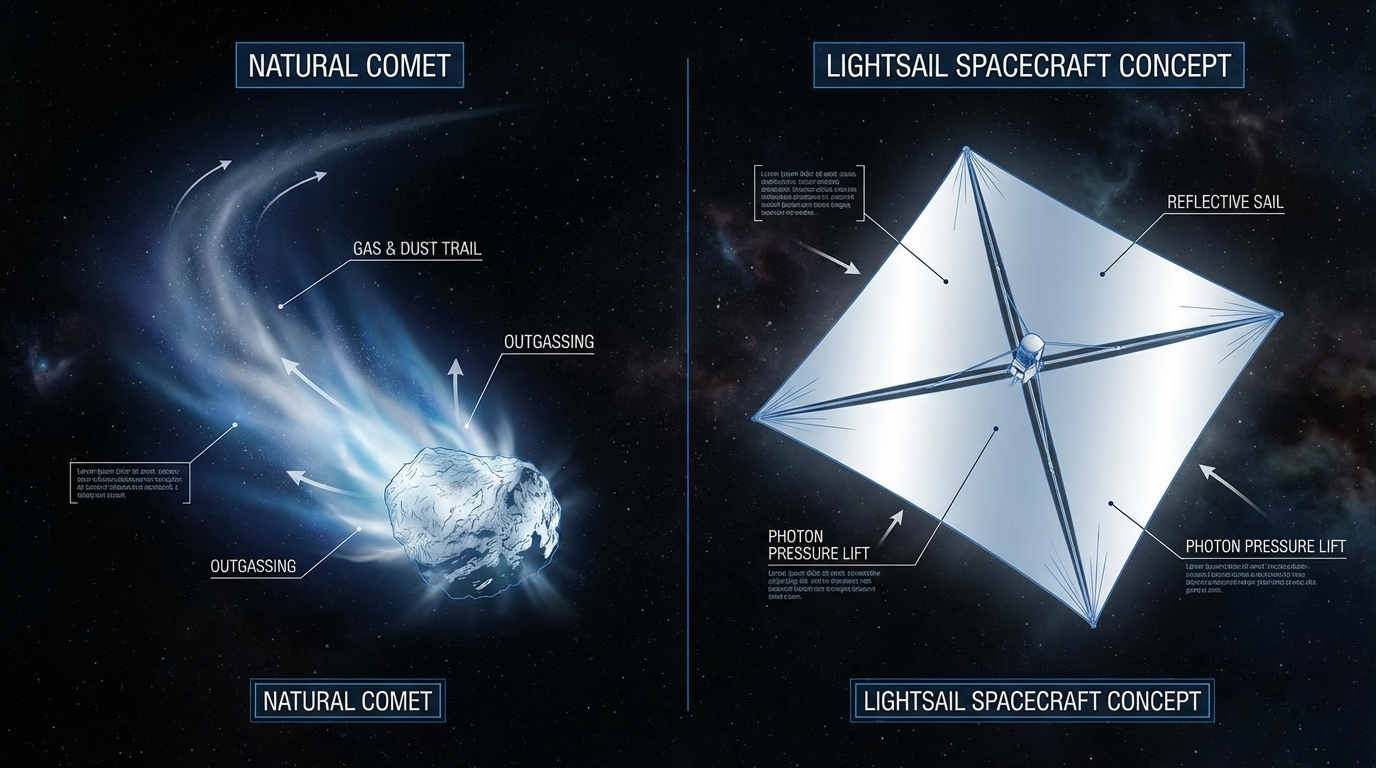
Conceptual comparison: natural comet with outgassing (left) vs. artificial lightsail propulsion (right)
Avi Loeb has argued that ʻOumuamua and other interstellar objects, including the reputedly interstellar meteor CNEOS 2014-01-08, are potential examples of alien spacecraft. His arguments have generated intense controversy, but he maintains they deserve serious scientific consideration.
| Anomaly | Loeb's Spacecraft Argument | Skeptics' Natural Explanation |
|---|---|---|
| 1. Non-gravitational Acceleration | The object was not just accelerating, but deviating from its expected trajectory by about one-tenth of a percent. There was no cometary tail around 'Oumuamua, and we don't see its spin changing as we would with outgassing, suggesting radiation pressure on a thin sail. | The observed acceleration was due to the release of entrapped molecular hydrogen that formed through energetic processing of an H2O-rich icy body. When ice is hit by high-energy particles akin to cosmic rays, H2 is abundantly produced and trapped within the ice. Cosmic rays can penetrate tens of meters into ice, converting a quarter or more of the water to hydrogen gas. |
| 2. Extreme Elongated Shape | Its reflection of sunlight suggested that its shape was much more elongated or flattened than any known asteroid or comet. Astronomers had never seen a natural object with such extreme proportions in the solar system before. This shape is consistent with a thin solar sail. | The best models show either a cigar-shape, 1:8 aspect ratio, or disc-shape, 1:6 aspect ratio, with the disc more likely. Being made of frozen nitrogen also explains the unusual shape of 'Oumuamua due to ablation. |
| 3. No Cometary Tail Despite Acceleration | It moved like a comet, but didn't have the classic coma, or tail, of a comet. The acceleration without visible outgassing is consistent with reflective surfaces like a lightsail being pushed by solar radiation pressure. | Unlike a comet, 'Oumuamua didn't have any noticeable tail, but astronomers couldn't detect the small dust and gas molecules that are normally associated with comets due to the object's small size and hydrogen-based outgassing being invisible. |
| 4. Origin from "Local Standard of Rest" | Its motion indicated that it originated from the so-called "local standard of rest" obtained by averaging the random motions of all nearby stars. This is unexpected for a naturally ejected object but consistent with an object designed for slow interstellar travel. | On its way in, it was observed to be on exactly the type of orbit that was expected for non-active interstellar objects. The velocity is within natural expectations. |
| 5. Statistical Rarity | If 'Oumuamua originated from a population of similar objects on random trajectories, its discovery would require the production of a thousand trillion such objects per star in the Milky Way — far more than the theoretical calculations suggest is natural. | It is well within the range of possibility that the exponent is 2 or larger, which would yield a number of ejected objects closer to 10¹⁵. This is an area of active research, with many unknowns, but it's not obvious at all that the number density of interstellar objects demands a non-natural explanation. |
| 6. Reflectivity and Color | The object's brightness variations and reflective properties are consistent with a manufactured surface rather than a porous natural object. | Its colors are consistent with D-type asteroids, comets, and even Pluto. Natural space weathering produces similar reddish hues. |
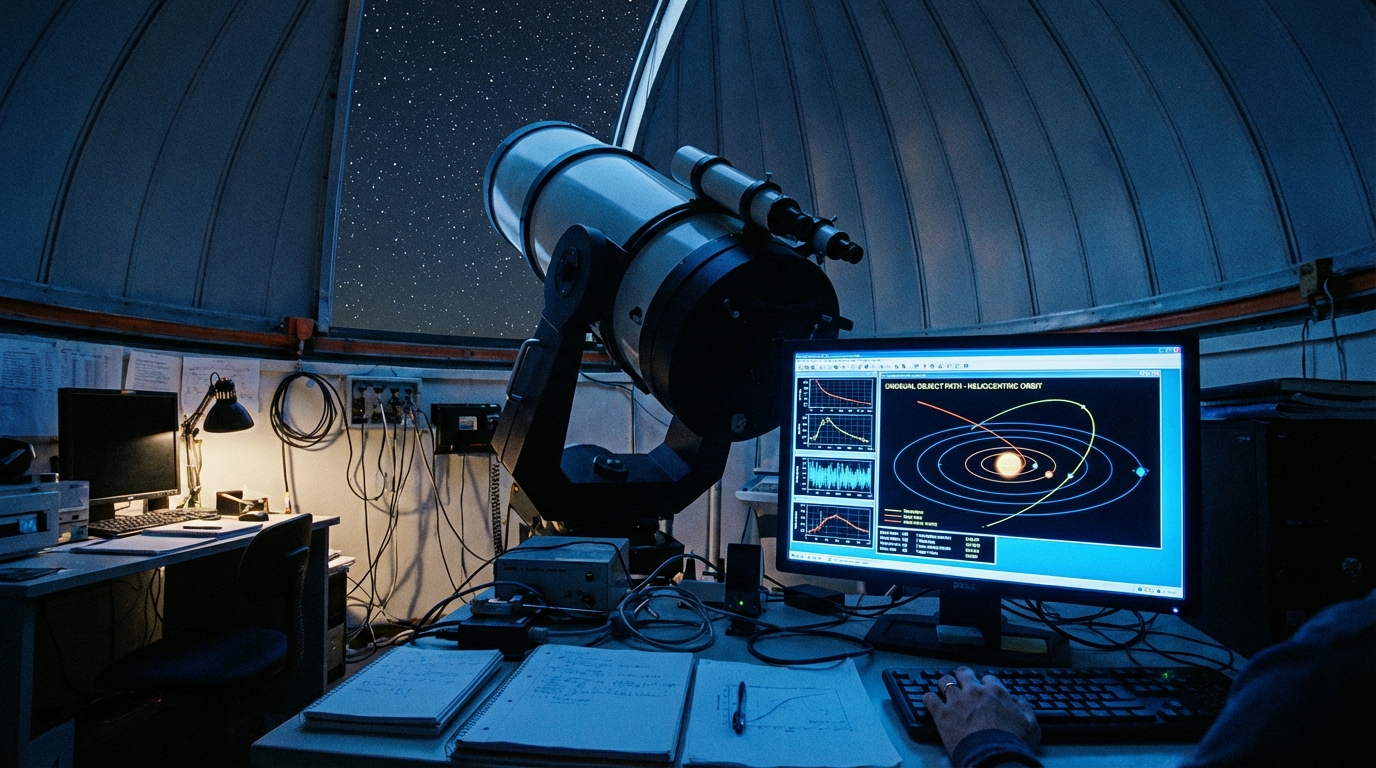
Astronomers worldwide are tracking 3I/ATLAS to understand its nature
In summer 2025, another interstellar object was discovered: 3I/ATLAS. It is unusually bright, has an odd trajectory and it is massive. Loeb has once again raised questions about its nature.
Latest Update (December 2025): On December 19, 2025, 3I/ATLAS reached its closest distance from Earth at 268.91 million kilometers. It did not maneuver or display any unusual activity on that occasion.
Loeb's claims have been widely rejected by the scientific community. The controversy highlights fundamental questions about the scientific method and burden of proof.
Loeb has stated that "ridiculing the notion that 'Oumuamua may have been artificial in origin will not get rid of our neighbors. As Galileo Galilei instructed us four centuries ago, the nature of celestial objects must be found through our telescopes rather than philosophical prejudice. The nature of 'Oumuamua is not a question that will be settled by philosophical arguments".
Loeb says: "I'm not claiming that I have 100% proof that it is, but I'm just saying, let's discuss it as a viable option and search for the next one that shows anomalies of this type".
After examining all the evidence, I believe the natural comet/asteroid explanation remains far more plausible than the spacecraft hypothesis for both 'Oumuamua and 3I/ATLAS. Here's why:
To consider the spacecraft hypothesis seriously, I would want to see:
The spacecraft hypothesis is not impossible, but it remains extraordinary. Extraordinary claims require extraordinary evidence—and we're not there yet. The natural explanations, while incomplete, are sufficient to explain the observations without invoking alien technology. However, Loeb is right about one thing: we should remain open-minded and continue gathering data. Science advances by testing hypotheses, not dismissing them out of hand.
The search for extraterrestrial intelligence is important. But premature declarations risk crying wolf—and may cause us to miss genuine signals when they eventually arrive.